


By: Daing Muhammad Zaquan Mohd Razi & Dr. Syazwan Saidin
SERDANG, 23 September 2026 — Forty-five Diploma students from the Department of Biology, Faculty of Science and Mathematics, Universiti Pendidikan Sultan Idris (UPSI), participated in an academic visit to the Institute of Bioscience, Universiti Putra Malaysia (UPM) as part of their Industrial Biotechnology (SBT1053).
The programme was coordinated by Dr. Syazwan Saidin, a lecturer from the Department of Biology, Faculty of Science and Mathematics, UPSI.
He was assisted by En. Muhammad Yusri Noordin and Pn. Norzalira Zalzali, both Assistant Science Officers, who accompanied the students and provided technical throughout the visit.
The academic visit was organised to extend biotechnology learning beyond the classroom by exposing students to a research-intensive environment. Through direct observation and interaction with research facilities, the students gained first-hand insight into how fundamental concepts learned in lectures and practical classes were applied in actual scientific settings.
A major highlight of the programme was the opportunity to explore several specialised facilities within the Institute of Bioscience. The students visited Makmal VacBio, the UPM Microbial Culture Collection (UPM-MCC), the Microscopy Unit, the Biodiversity Unit and Makmal Natur Meds.
These visits enabled them to observe the research infrastructure, specialised equipment and technologies used in contemporary bioscience research.
The exposure provided the students with a clearer understanding of how scientific investigations were conducted in a professional research environment. It also demonstrated how different areas of expertise contributed collectively to biotechnology research, innovation and scientific advancement. Beyond laboratory techniques, the visit broadened the students’ understanding of the wider professional practices that supported bioscience research.
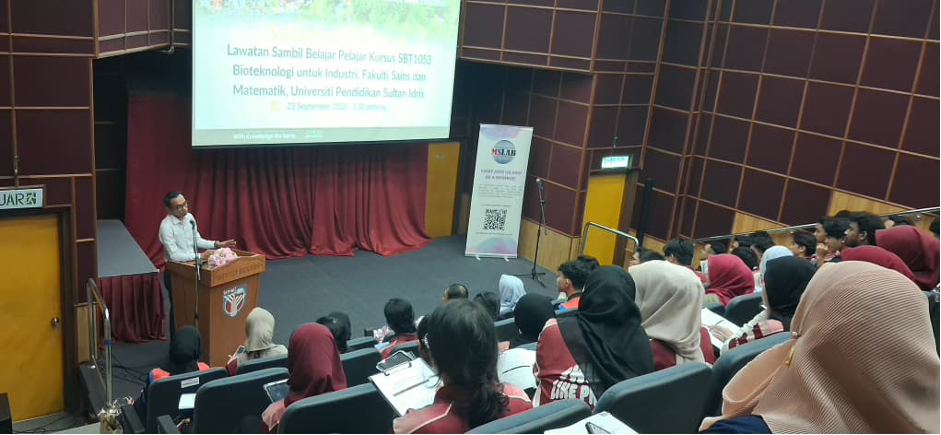

They were able to appreciate the importance of specialised instrumentation, laboratory management, quality control, multidisciplinary collaboration and scientific innovation in ensuring high-quality research outcomes.
For the Diploma students, the visit offered valuable insight into potential career and further-study pathways in biotechnology and related fields, including laboratory research, microbiology, molecular biology, biodiversity, pharmaceuticals, agriculture and other areas of bioscience.
Overall, the academic visit gave the students meaningful exposure to the broader scientific ecosystem in which research, innovation, technical expertise, laboratory professionalism and collaboration worked together.
More importantly, it helped bridge the gap between classroom learning and real-world bioscience research, giving the students a clearer understanding of how their Diploma-level education could prepare them for future studies and careers in biotechnology.