

Prepared by: Vidyadarshinee Ravindran & Dr. Ahmad Sauffiyan Abu Hasan
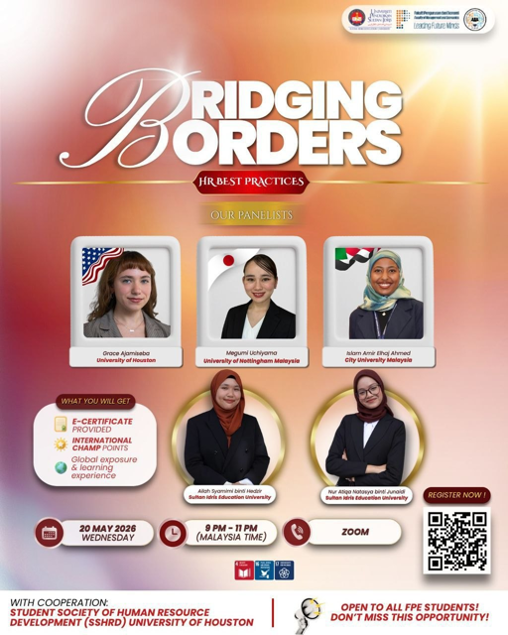
Tanjong Malin, 20 May – An international panel was brought together by voices from Japan, Sudan, and Malaysia for the forum titled Bridging Borders: HR Best Practices to examine workplace culture, labour legislation, talent retention, and the future of work live via the Google Meet platform which was organized by the Human Resources Management Club for the session 2025/2026 on 20 May 2026 from 9 p.m until 11 p.m at night.
The programme, organised by the Faculty of Management and Economics, drew together five international and local panelists for a wide-ranging dialogue on HR realities across three nations. Participants were eligible for both an International Champ recognition and an E-Certificate upon completion.
The evening was formally opened by Dr. Khalizul bin Khalid, Deputy Dean of the Faculty of Management and Economics, whose opening address set the tone for an engaged and reflective evening of cross-cultural exchange and welcomed several panelists including Megumi Uchiyama representing Japan from University of Nottingham, Kaho Yamada also representing Japan from Tsuda University, Tokyo, Islam Amir Elhaj Ahmed representing Sudan from City University Malaysia, Ailah Syamimi binti Hedzir and Nur Atiqa Natasya binti Junaidi representing Malaysia from the Sultan Idris Education University (UPSI).
Opening the first session with questions regarding workplace culture and labour legislation was questioned to Megumi Uchiyama who painted a vivid picture of Japan’s deeply collective work culture. Loyalty to the company and contribution to the team remain the pillars of professional identity and those who cultivate strong workplace relationships consistently leave a more favourable impression than those who prefer to stand out individually. “Japanese employees do not flaunt their achievements as they focus more on cumulative work performance and achievement,” Megumi explained.
On the legislative side, she noted that Japan’s labour laws are structured to protect workers from unfair dismissal and to uphold standards around pensions and workplace safety. A notable development in recent years has been the government’s push to curb excessive overtime where legal limits are now firmly in place and companies that breach them face penalties therefore policies also now require employees to actually take their paid leave to fully utilize their rights.
“The pandemic encouraged employees to use work hours more flexibly — and for the first time, many began to reflect seriously on their own work style.”
Megumi elaborated on how the COVID-19 pandemic acted as an accelerant for Japan’s long-overdue work-life balance conversation. Industries such as food and beverage remained largely unchanged by necessity, but knowledge-based sectors have increasingly moved toward hybrid arrangements. The traditional pride in working long hours or in remaining with a single employer for decades is now being omitted for the betterment.
For fresh graduates entering Japan’s workforce, the landscape remains highly competitive. Preparation for job hunting can begin well over a year before graduation, and the expectation to secure employment immediately after university is still deeply ingrained. Students invest heavily in refining interview etiquette and communication skills, knowing that interpersonal polish often carries more weight than academic results alone.
Representing Sudan, Islam Amir Elhaj Ahmed offered a different perspective shaped by a culture in which the workplace is treated as a second family. The concept of “saving face” is crucial as managers rarely deliver direct negative feedback, opting instead for softened language or diplomatic phrasing. Doing otherwise risks being labelled as rude, since employees often internalise criticism personally rather than professionally.
Hiring in Sudan is predominantly relationship-driven as tribal background and nepotism frequently outweigh qualifications and skill as a job offer is far more likely to follow from a family connection than from credentials alone. Work-life balance, meanwhile, is interpreted quite differently than in most other countries: Sudanese workers do not typically separate leisure from life.
Sudan’s labour framework sets a 48-hour, six-day working week. Maternity leave stands at eight weeks by law and it has become normalised for women to take one to two years of unpaid leave thereafter. Equal pay for equal work is enshrined in law, but enforcement remains inconsistent, and employees routinely work beyond their contracted hours without recourse.
On entry into the workforce people requires to have networking to get hired which posed as a great difficulty for graduates. The ongoing conflict in Sudan has further reduced hiring, and many graduates now choose to emigrate in search of opportunities rather than remain in an environment with no internship culture and limited formal pathways into employment.
The second session opened with questions regarding remote work, retention, artificial intelligence and the gig economy with Kaho Yamada addressing Japan’s evolving relationship with remote work. She reiterated Megumi’s earlier points on how the pandemic normalised flexible scheduling, and employees have since valued the ability to reduce commute times and better manage caregiving responsibilities.
On talent retention, Kaho flagged cost-of-living pressures as an increasingly significant concern. Rising prices for daily necessities and fuel are squeezing household budgets, complicating employers’ efforts to retain staff on stagnant wages. When asked whether artificial intelligence poses a threat to Japan’s workforce, her response was measured: “Companies still value people and the spirit of omotenashi — genuine hospitality,” she said. “AI will support workers, not replace them.”
On the gig economy, Kaho noted that platforms such as food delivery services have become a popular channel for supplemental income, particularly among younger workers who are turning hobbies into income streams through social media. Yet anxiety about the absence of insurance, stable income, and employment benefits keeps most graduates gravitating toward traditional corporate careers despite the appeal of independence.
Islam explained that remote work in Sudan and how the current security situation has made remote work not merely a preference but a matter of personal safety due to the ongoing war and conflicts in the country. Businesses have adapted by operating across different states entirely, and remote employment has proven a lifeline for many. The sustainability of this model, however, is undercut by severe infrastructure deficits: reliable electricity is unavailable for up to twelve hours a day in parts of the country, and internet connectivity is far from universal.
“Infrastructure barriers such as power cuts of up to twelve hours a day, limited internet access poses as a challenge for remote work.” she explained.
On artificial intelligence, she stated that roughly nine out of ten workers still rely entirely on face-to-face interaction, artificial intelligence remains largely irrelevant to daily working life. The gig economy, meanwhile, has become a survival mechanism rather than contract-based remote roles that pay in foreign currencies are now pulling young talent away from local companies at an accelerating rate, presenting a structural challenge that HR practitioners can no longer afford to ignore.
The Malaysian perspective was woven throughout both sessions by Ailah Syamimi binti and Nur Atiqa Natasya binti Junaidi to summarize the topic and questions in Malaysia’s perspective to exchange knowledge.
The evening concluded with a lively audience Q&A, reinforcing the spirit of the event that understanding the diversity of HR practice across borders is not merely academic it is essential preparation for a workforce that is increasingly global, hybrid, and complex and gave students insights on how to integrate said information in their future work in HR.